RMM platforms for MSPs: 104 products, 35 with an MCP server, and how to choose
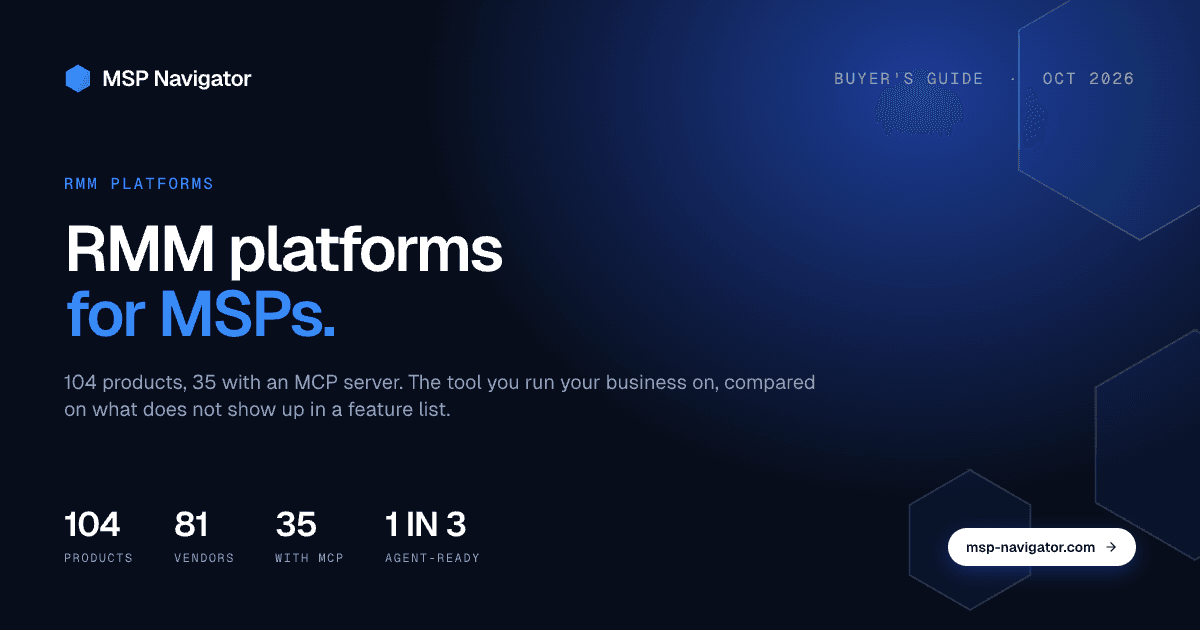
The RMM is the tool an MSP runs its business on. It is where the agents live, where patching happens, where alerts start and where most technicians spend their day. Choosing one is a five-year decision, and switching is the project nobody wants to do twice. The catalog lists 104 products from 81 vendors under RMM Platforms as of October 2026. This guide is built from what the catalog knows about them: who makes them, what they integrate with, and which ones an AI agent can already operate.
Key facts, October 2026
- 104 RMM products from 81 vendors, all through the capability audit.
- 35 have a verified MCP server, 76 a public API, 10 a CLI. One in three RMMs is agent-ready, the highest share of any category.
- 70 of 104 are internal tooling the MSP runs and recovers in its service fee; 27 are also licensed by some clients; 7 are resold. RMM is a sell-to category.
- Verified PSA integrations: ConnectWise PSA 21, Halo PSA 20, Autotask 18.
- NinjaOne and AnyDesk are the two products with API, CLI and MCP all documented.
What the category covers
RMM Platforms holds remote monitoring and management tools: an agent on every endpoint, monitoring and alerting, patch management, scripting and automation, remote access, and usually software deployment and asset inventory. The boundary is fuzzy at the edges, and the catalog reflects it.
- Full RMM platforms aimed at MSPs: the household names and a long tail of smaller ones.
- Remote access tools that grew management features, or that MSPs use alongside a lighter RMM.
- Microsoft 365 and cloud management products that behave like an RMM for tenants rather than endpoints; CIPP is the obvious example.
- Automation layers that sit on top of an RMM and PSA rather than replacing them.
Endpoint security, MDM and network monitoring have their own subcategories, and the overlap is real: several products appear in two.
Sell to, not sell through
The use-or-resell verdict for RMM is the mirror image of email security.
| How MSPs relate to it | Products |
|---|---|
| Internal tooling: you run it, clients never buy it | 70 |
| Both: you run it and some clients license it directly | 27 |
| Resold to clients | 7 |
RMM is a cost of doing business, priced per endpoint and recovered inside your managed service fee. The 27 "both" products are mostly remote access and co-managed IT scenarios, where a client's internal IT team wants the same console. The 7 resell-only products are not really RMMs for MSPs; they are endpoint management tools sold to end customers that happen to list here.
So the buying questions are what it costs per endpoint at your scale, how much technician time it saves, and whether it will still be the right platform when you are twice the size.
The landscape in numbers
- 104 products, 81 vendors. Fewer multi-product vendors than most categories: Barracuda lists 4, N-able, Kaseya, CIPP and ConnectWise 3 each, NinjaOne, Naverisk, GoTo and MSP Builder 2.
- A big-vendor category. 31 products come from vendors with more than a thousand staff, 26 from mid-sized vendors and 32 from vendors with 50 people or fewer. Consolidation has concentrated the platform business, while the small-vendor end is remote access and automation add-ons.
- Geography. 59 products from the US, 8 from the UK, 4 each from New Zealand, Germany and Canada. The Australasian MSP market has produced several RMM vendors, which is why New Zealand appears at all.
- AI claims are moderate. 41 of 104 products carry an AI feature flag, mostly for alert triage and scripting assistance.
Agent-readiness: the best category in the catalog
RMM is where MCP has landed first.
| Capability | Products | Share |
|---|---|---|
| Public API | 76 | 73% |
| MCP server | 35 | 34% |
| CLI | 10 | 10% |
| All three | 2 | 2% |
One in three RMM products has a verified MCP server, against one in nine across the whole catalog. The list includes the platforms most MSPs actually run: Datto RMM, Kaseya VSA, NinjaOne, N-able N-central and N-sight, ConnectWise RMM and the Asio platform, SuperOps, Pulseway, Automox, ImmyBot, Domotz, TeamViewer and CIPP. NinjaOne and AnyDesk are the two products with API, CLI and MCP all documented.
The RMM is the system an agent most needs to touch. "Which of client X's servers missed last month's patches", "restart the print spooler on these three machines", "show me every endpoint without the EDR agent" are RMM questions. When your RMM has an MCP server, an agent connected to your stack can answer them directly, with the RMM's own permissions model deciding what it may do. When it only has an API, someone has to write and maintain the glue. The same applies to the catalog itself: the developers page shows how an agent queries it.
The 28 products with an API but no MCP server are the ones to watch over the next year. Ask your vendor where it is on their roadmap.
PSA integrations
RMM is the category where PSA integration is a given rather than a differentiator.
Halo nearly matches ConnectWise. Two years ago that list would have been ConnectWise, Autotask and a gap. If you run Halo, the RMM choice is no longer constrained by it.
What actually separates products
Feature lists converge. These six things do not.
- Automation depth. Scripting is table stakes. The differences are in the policy engine: can you express "patch all servers in this ring on the second Tuesday, except these, and roll back if the service does not come up" without a script, and can you apply it across all clients at once.
- Agent footprint and reliability. The agent runs on every device you manage. Ask for the memory and CPU numbers, how it survives a bad update, and how it behaves on a laptop that is off the network for a month.
- Multi-tenant hygiene. Client separation, technician roles per client, and audit logs that would satisfy a client's compliance questionnaire.
- Patch coverage beyond Windows. Third-party application patching, macOS and Linux parity, and whether the vendor maintains the patch catalog or you do.
- Openness. Public API with documentation you can read before you sign, webhooks, and now MCP. This is also your exit path: a platform you can get your data out of is a platform you can leave, which keeps the vendor honest at renewal.
- Pricing at your scale. Per-endpoint pricing with minimums and tiers, and what happens to the price when you add 500 endpoints in a quarter. Get the numbers for double your current size.
Questions to ask in the demo
- Build one patch policy with me, with an exclusion and a maintenance window, and apply it to two clients.
- Show me an alert from the moment it fires to the ticket in my PSA, and show me how to stop that alert class from ever paging again.
- What does the agent cost in CPU and memory, and how do you roll back a bad agent release?
- Which API endpoints are documented publicly, and is there an MCP server? If yes, which operations does it expose, and how does it inherit technician permissions?
- How do I export everything, devices, scripts, policies and history, if I leave?
- What does onboarding 300 endpoints from a competitor look like, and who does the work?
How to use the catalog for this
The category page lists all 104 products. The MCP filter gives the shortest useful list in the category right now, and the PSA filter shows which RMMs integrate with yours. Each product page links to the documentation that earned its flags, and each vendor page shows the rest of that vendor's stack, which matters for the suite-versus-best-of-breed decision. Missing one? Paste the URL and the system adds it.
Frequently asked questions
Which RMM platforms have an MCP server?
Thirty-five of 104 in October 2026, including Datto RMM, Kaseya VSA, NinjaOne, N-able N-central and N-sight, ConnectWise RMM, SuperOps, Pulseway, Automox, ImmyBot, Domotz, TeamViewer and CIPP. The full list is on the category page with the MCP filter applied.
Is an RMM something MSPs resell?
Rarely. 70 of 104 products are classified as internal tooling the MSP runs and recovers inside its service fee; 27 are also licensed directly by some clients, usually co-managed IT; 7 are resold.
Which PSA do most RMMs integrate with?
ConnectWise PSA with 21 verified integrations, Halo PSA with 20 and Autotask with 18. The spread is narrow enough that the PSA no longer dictates the RMM choice.
How many RMM vendors are there?
81 vendors behind 104 products. Most list one product; Barracuda, N-able, Kaseya, CIPP and ConnectWise list three or more.
What is the difference between RMM and MDM?
RMM manages computers and servers through an installed agent with monitoring, patching and scripting. MDM manages phones, tablets and increasingly laptops through the operating system's enrolment framework, with policy rather than scripts. Many MSPs run both; the catalog lists MDM separately under Endpoint & Device Management.
Numbers are from the MSP Navigator catalog on 11 October 2026: 104 published products in RMM Platforms, all through the capability audit. Capability flags are verified against vendor documentation and linked on each product page. PSA integrations count products with a verified integration, not the depth of it. When the numbers change, this page is refreshed, not rewritten. Related guides: Email security for MSPs, Data loss prevention for MSPs.